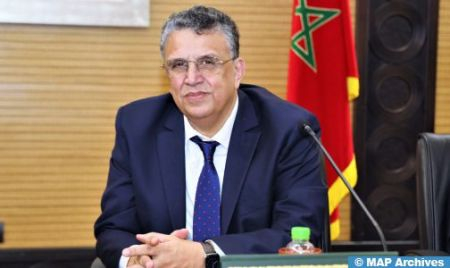
In an address read on his behalf by the Secretary-General of the Interministerial Delegation for Human Rights (DIDH), during a thematic session on “Transitional Justice and Constitutional and Legislative Reforms,” held as part of the International Symposium on Transitional Justice, Ouahbi stressed that the commission completed its work in November 2005, submitting its final report, which includes relevant recommendations on reform, rehabilitation and reconciliation approaches to ensure that these violations do not recur.
In His speech on March 9, 2011, he recalled, HM King Mohammed VI said that the IER’s recommendations were one of the main pillars of the 2011 constitutional reform, noting that Morocco had responded, within five years of the presentation of the IER report, with relevant recommendations, thus ranking the Moroccan experience by the UN among successful international experiences.
He added that this constitutional reform gave rise to an unprecedented legislative momentum which laid the foundations for structured reform projects, enabling a qualitative leap forward in terms of harmonization with international human rights standards and the provisions of the Constitution, which included the various relevant recommendations of the IER.
For his part, the Vice-Chairman of the UN Committee against Torture, Abderrazak Rouwane, pointed out that Morocco’s experience of breaking with past violations is very special, characterized by a national debate led by civil society associations, which was in line with the will of the State and national human rights institutions, unlike other experiences around the world which took place in contexts characterized by a brutal break with the past.
After recalling the fundamental components of transitional justice, namely the establishment of truth, justice, reparations and guarantees of non-repetition, Rouwane indicated that since the 1990s Morocco has launched a series of procedures and measures on the treatment of past violations, as well as other reforms of criminal procedure, notably with regard to arbitrary detention and preventive detention.







Comments
0